
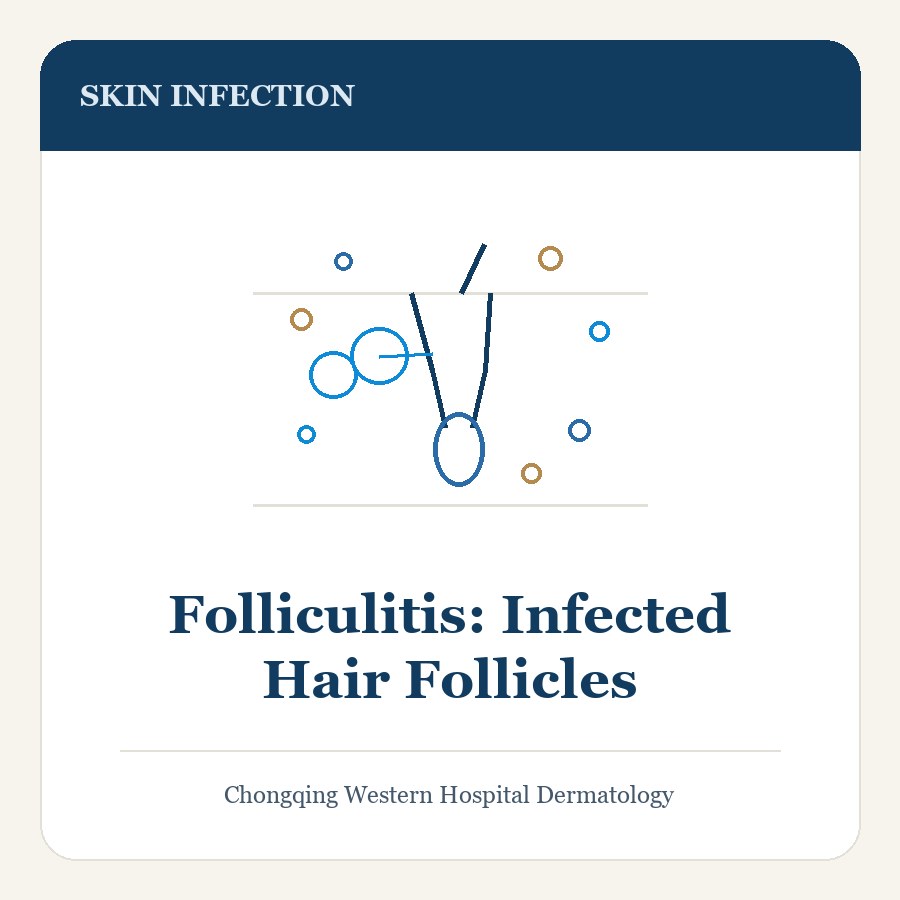
In short. Folliculitis is inflammation of the hair follicles, appearing as small red bumps or pustules each centred on a hair. Bacterial, yeast and other forms look alike and need different treatment, so the cause is identified by sampling before treatment is chosen. Many people treat it as acne for months without improvement.
Key points
- Folliculitis is inflammation of hair follicles, with pustules centred on a hair.
- Bacterial, yeast and other forms look alike but need different treatment.
- Sampling identifies the organism and, in recurrent infection, its antibiotic sensitivities.
- Recurrent crops usually mean an unaddressed mechanism rather than a new infection.
- Superficial folliculitis usually settles within one to two weeks of correct treatment.
What does folliculitis look like?
Folliculitis is inflammation of hair follicles. It appears as small red bumps or pustules, each centred on a hair, and it is most common on the scalp, beard area, back, chest, buttocks, and legs. Many people treat it as acne for months without improvement, because the two look alike at a glance but do not respond to the same treatment. Identifying the cause is what makes folliculitis treatable.
The main types, and why the differences matter
Bacterial folliculitis, usually caused by staphylococci, produces tender pustules and may follow shaving, plucking, or friction from clothing. Yeast folliculitis, caused by the same Malassezia yeast involved in seborrhoeic dermatitis, tends to itch more than it hurts and is often widespread on the back and chest. Gram-negative folliculitis can appear after prolonged antibiotic treatment for acne. A hot-tub or spa exposure can produce a distinctive eruption within days. When follicles are inflamed more deeply, a furuncle or carbuncle forms: a painful, firm, enlarging nodule that needs medical treatment. Recurrent boils in the armpits or groin may instead be a different disease, hidradenitis suppurativa, which is managed quite differently.
Why sampling decides the treatment
Sampling is what separates the types. A swab of pus sent for bacterial culture identifies the organism and, importantly, its antibiotic sensitivities when infection is recurrent or resistant. A scraping examined under the microscope detects yeast forms. When folliculitis is deep, recurrent, or fails to respond, a skin biopsy can confirm the pattern and exclude other conditions. In recurrent bacterial infection, nasal or skin carriage of staphylococci may need to be addressed alongside the skin itself.
| Type | What it looks like | What usually causes it | What treats it |
|---|---|---|---|
| Bacterial | Tender pustules | Staphylococci, often after shaving, plucking or friction | Topical antibacterial; oral if extensive or deep, guided by culture |
| Yeast | Itches more than it hurts, often widespread on the back and chest | Malassezia, the yeast involved in seborrhoeic dermatitis | Topical or oral antifungal, not antibacterials |
| Gram-negative | Appears after prolonged antibiotic treatment for acne | Gram-negative organisms | Treatment chosen according to culture results |
| Hot-tub associated | A distinctive eruption within days of exposure | A hot tub or spa | Prompt review, because the cause and treatment differ |
| Furuncle or carbuncle | A painful, firm, enlarging nodule | Deep inflammation of the follicle | Medical treatment, possibly drainage and systemic treatment |
| Hidradenitis suppurativa | Recurrent boils in the armpits or groin, with tunnels and scars | A different disease | Specialist management |
Treatment classes
Limited bacterial folliculitis is treated with topical antibacterial preparations, with oral antibiotics reserved for extensive or deep infection and chosen according to culture results. Yeast folliculitis responds to topical or oral antifungal therapy, not to antibacterials. Measures that reduce friction, occlusion, and shaving trauma are part of every plan, and antiseptic washes are used selectively to avoid irritation and resistance.
The mechanism behind recurrent crops
When folliculitis keeps coming back, there is normally a reason: shaving technique against the grain, occlusive sportswear, a hot tub, an inadequately treated course of antibiotics, or a reservoir of bacteria on the skin or in the nose. Treating each crop in isolation without addressing the mechanism produces an endless cycle. Culture-guided treatment plus a change in the provoking habit is what actually ends it.
Follow-up and honest limits
Superficial folliculitis usually settles within one to two weeks of correct treatment. Deep infection takes longer and may leave scarring or pigment change. People with recurrent disease may need a longer maintenance plan, and resistance to commonly used antibiotics is a genuine and growing problem that makes culture-guided treatment more important rather than less.
When should it be reviewed promptly?
A bump that becomes large, firm, increasingly painful, or is accompanied by fever or spreading redness needs prompt review, because deep infection may need drainage and systemic treatment. Boils that keep recurring in the armpits, groin, or under the breasts, or that form tunnels and scars, may be a chronic condition requiring specialist management. Folliculitis that is extensive, follows a hot tub or spa, or appears while you are taking antibiotics or are immunosuppressed should also be reviewed, because the cause and treatment differ in each case.
Sources
Internal links
Frequently asked questions
Why do many people treat folliculitis as acne for months?
Because the two look alike at a glance, but they do not respond to the same treatment. Folliculitis is inflammation of hair follicles and needs the cause identified, whether bacterial, yeast, or another type, before the right treatment can be chosen.
How is the cause of folliculitis confirmed?
By sampling. A swab of pus sent for bacterial culture identifies the organism and its antibiotic sensitivities when infection is recurrent or resistant, a scraping examined under the microscope detects yeast forms, and a biopsy is used for deep or unresponsive cases.
Why does folliculitis keep recurring?
Usually because the mechanism has not been addressed: shaving against the grain, occlusive sportswear, a hot tub, an incompletely treated antibiotic course, or a reservoir of bacteria on the skin or in the nose. Culture-guided treatment plus changing the provoking habit is what ends it.
Risks & Limitations
- Most chronic skin disease is managed rather than cured, and relapse is expected.
- Treatments typically need 8–12 weeks before response can be judged fairly.
- Topical treatment can cause irritation, dryness, peeling and photosensitivity.
- Systemic therapy may require blood monitoring and carries organ, metabolic and pregnancy risks.
- Isotretinoin in particular requires strict monitoring and pregnancy prevention.
- Pigment change is often slow and may be incomplete.
- No treatment works for everyone, and response cannot be predicted with certainty.
When to Seek Care
- A mole or lesion that changes in size, shape or colour, or starts to bleed, itch or crust.
- Fever with a widespread rash, blistering, or rash involving the eyes, mouth or genitals — seek emergency care.
- Rapidly spreading redness, swelling or pain in the skin.
- Facial swelling or difficulty breathing — possible severe reaction; seek emergency care immediately.
- New or worsening symptoms while taking a monitored medication.
References & Further Reading
- American Academy of Dermatology (AAD) — public and clinical guidance
- World Health Organization (WHO) — skin and infectious disease resources
- Chinese Medical Association, Dermatology Branch — clinical guidance
- Cochrane Library — systematic reviews in dermatology
This page is patient education, not medical advice, and it does not cite individual studies. Discuss your own case with a qualified clinician. To arrange an assessment at Chongqing West District Hospital, see Contact & Consultation.